Brad Guider · Work

Selected work.

Different systems. One question: what evidence makes them dependable?

A selection of products, testing frameworks, and experiments I have designed and built.

From requirement to working system.

Quality engineering platform · Public site & docs

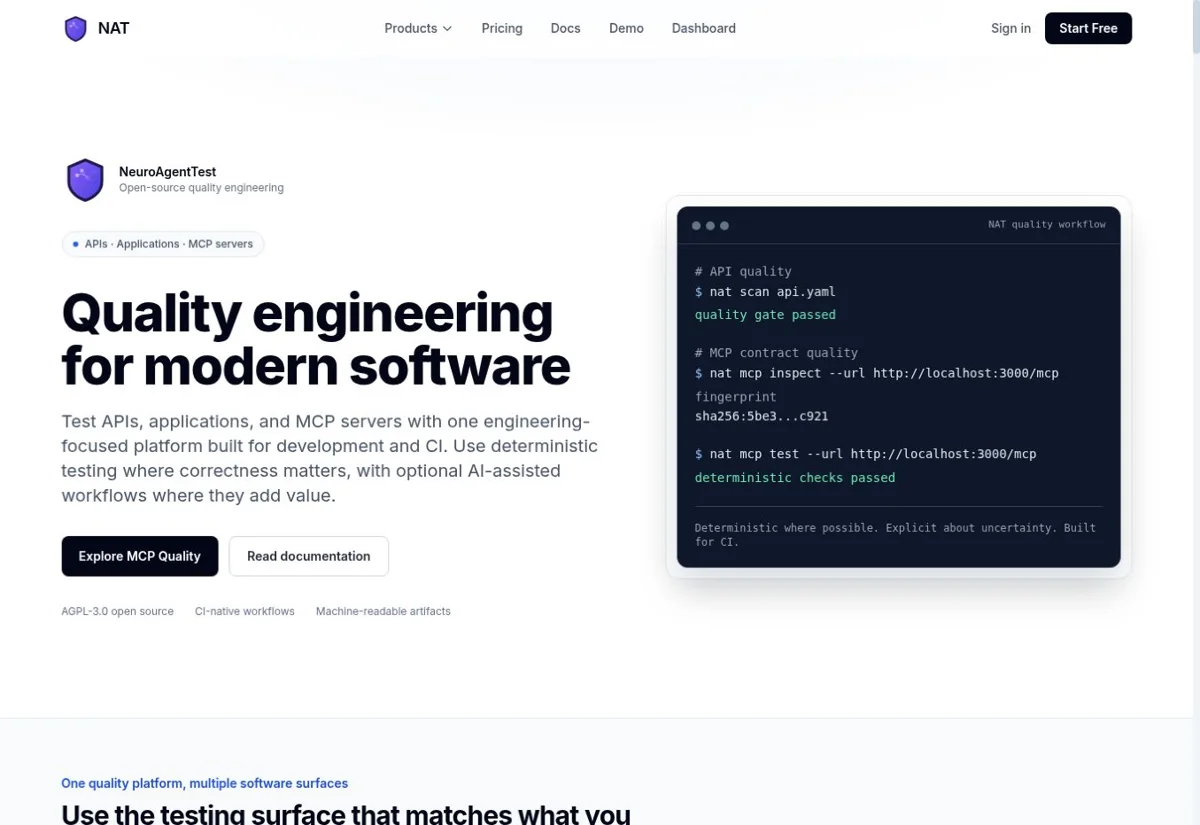
NAT

Quality engineering for APIs, applications, and MCP servers.

NAT brings testing, security checks, and CI evidence into a shared engineering workflow. Its MCP Quality layer inspects contracts, detects drift, runs checks, and produces machine-readable artifacts.

My contribution
System architecture, testing methodology, product development, and quality gates.
What matters
Deterministic release evidence, with optional AI assistance where it adds value.
Visit NAT ↗MCP Quality ↗Documentation ↗
NAT public product site
NAT public product site · October 2026

Independent product · Live

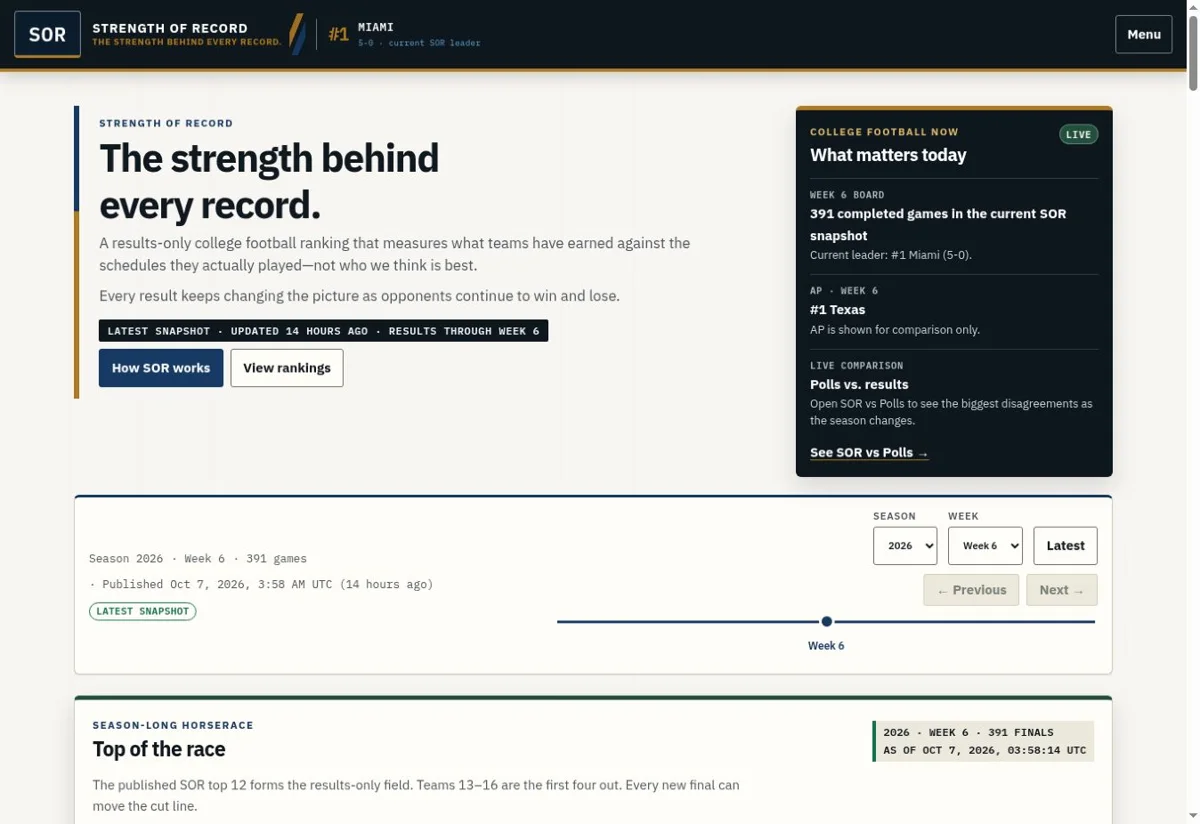
Strength of Record

A transparent ranking system brought into daily public use.

SOR measures how difficult a team's record would be to reproduce against its schedule. The product turns that model into rankings, team comparisons, historical views, and shareable fan experiences.

My contribution
Ranking methodology, data pipeline, product direction, frontend experience, and release verification.
Engineering decisions
Validated publication, API-owned calculations, and frozen history kept separate from changing live results.

SOR Intelligence explores predictive analysis separately from the canonical results-only ranking.

Visit the product ↗Team Compare ↗SOR Intelligence ↗
Strength of Record public product site
Strength of Record public product site · October 2026

Quality engineering workbench · Private prototype

QAgent

Expose decisions. Compress mechanics.

QAgent translates business intent into governed test behavior, application-grounded interactions, generated automation, and execution evidence. The practitioner retains authority over consequential testing decisions.

My contribution
Product thesis, authority and evidence contracts, guided workflow, and acceptance design.
Current maturity
VP0.1–VP0.8 engineering acceptance is frozen complete. Independent practitioner usefulness validation remains pending.
Ask about QAgent →

BGSTM

Keep the tools you already use. Connect the quality evidence they produce.

Better Global Software Testing Methodology provides six phases for planning, designing, preparing, executing, analyzing, and reporting testing. It adapts to Agile, Scrum, Waterfall, and hybrid delivery.

I authored the methodology and built its reference application. The application demonstrates the approach; adopting it does not require adopting my software.

Read the documentation ↗Repository ↗
  1. 01Test Planning
  2. 02Test Case Development
  3. 03Test Environment Preparation
  4. 04Test Execution
  5. 05Test Results Analysis
  6. 06Test Results Reporting

Rules & Purpose Lab

Passing the checks is only part of the answer.

A runnable customer-support exercise showing how contract compliance and purpose evaluation contribute different evidence to a release decision. One customer request, four responses: a correctly formatted answer can miss the task, while useful advice can still break an integration.

My contribution
Evaluation harness, evidence reports, release policy, and a guided repair workshop for QA engineers, developers, and business analysts.
What learners inspect
Why changed responses need fresh assessment, why graders can disagree, and how each decision follows from its evidence.
Explore the lab ↗Try the workshop ↗View the slides ↗

Educational lab using synthetic examples. Teaching effectiveness awaits a participant trial.

One request. Four outcomes.
Contract
checks
Purpose
assessment
Scenario
decision
PassFailBlock
FailPassBlock
FailFailBlock
PassPassEligible
Authored teaching examples, not measured model performance. Eligible applies only to the evaluated scenario and criteria; it does not authorize production release.

Browser automation · Teaching reference

Playwright Snippets

Focused TypeScript examples for common testing decisions: reuse a login, wait for observable readiness, control an API response, and retain failure evidence.

The learning task Choose one pattern, understand its assumptions, and adapt it to your application's contract.

Type-checked and discovery-validated. Examples require adaptation and execution against your own app.

Browse the patterns ↗Inspect a readiness example ↗

Accessibility · Hands-on learning lab

axe-check

A small accessibility CLI with paired broken and corrected pages. Inspect rule IDs and affected markup, repair a practice copy, then rerun the scan.

The learning task Repair four intentional blocking rules, then check keyboard behavior and feedback that the scan alone cannot establish.

A passing automated gate does not establish WCAG conformance. Manual accessibility evaluation remains necessary.

Try the accessibility lab ↗Inspect the CLI ↗

Case management · Integrated QA lab

Case Lifecycle QA Lab

A synthetic claims workflow connects requirement-linked UI and API tests, stale-update protection, visual regression, and CI evidence.

The learning task Trace Intake → Triage to its checks, then inspect how an outdated update is rejected without losing another user's saved work.

Independently built mock using synthetic data. Current tests cover Intake → Triage, not live Pega or the complete lifecycle.

Explore the lab ↗View the test report ↗

The result is part of the work.

Controlled experiments with defined acceptance rules, recorded outcomes, and explicit limits.

Business-intent validation · Public lab

Salesforce Change Impact Lab

Tests whether changed validation rules, flows, and permissions still enforce the protected business requirement.

GO / NO-GOValid metadata can still represent an unsafe change.

Credential-free, deterministic proof across three governed controls.

Read the case study →

Agent reliability · Completed experiment

Agent Crash Lab

Tests an autonomous browser agent under a frozen, deterministic disruption. Server-side state determines success.

18 recoveries / 2 failuresTwenty valid runs under one frozen configuration.

A finite-sample result, not a universal agent reliability claim.

Inspect the evidence ↗

Record reconciliation · Completed experiment

CRM Account Reconciliation Lab

Compares a probabilistic baseline with an AI-assisted cascade on synthetic Salesforce Account records.

8 of 9 criteria passedCalibration failed. The v1 verdict remained KILL.

Synthetic data; no live Salesforce connection or Account merging.

Read the findings ↗

Research & practical frameworks.

Research Swarm

AI-assisted orchestration for structured, repeatable research workflows.

Repository ↗

Foreknowledge Engine

A research exploration of multi-agent intelligence analysis and query-aware signal filtering.

Ask about the research →

Portfolio reviewed October 2026. Project links provide further detail and current status.

What are you trying to make more dependable?

Tell me about your system, your team, and the problem you need to solve. We can start with a conversation about where I can help.